Why I Chose to Become a Recreational Therapist

“Your new brother is going to have Down Syndrome”. I still remember the moment my mother announced this information to my siblings and I clear as day. The uncertainness in her eyes and her notable will to commit to this next step of her motherhood. I was a freshman in high school at the time was rather absorbed in my studies. Her proclamation took me by complete and utter surprise. This was the last thing I expected. I already had four younger siblings and the challenges that having a brother with Down Syndrome might’ve entailed flustered me.

But what even were the challenges? I didn’t know hardly anything about Down Syndrome and initially grouped it with autism and imagined severe dysfunction. I confided in a few close friends about the matter and was met with countless, “I’m sorry’s.” But sorries for what? Curious as to what I should expect, I began to investigate. I joined a club at my school called, “Mosaic Club”. I began working with Special Needs children in this way, and quickly found that it wasn’t so scary. They lived simply and were very much in the present, focusing on whatever task was at hand…be it coloring, eating, or other, more active, things. They were some of the most compassionate individuals I had the pleasure of meeting, constantly hugging and hand holding others in the club. 

My brother, Luke, has been the happiest baby and toddler, constantly smiling up at us with his big blue eyes and laughing at the simplest of things. He has a huge passion for music and is extremely emotionally comprehensive, mirroring how each of us are feeling, be it joyful or sad. He has truly brightened each and every day of my life. 

I began to wonder, and still do, why such a negative stigma often surrounds this community. Modernly, much has been done to break this negative mindset, but there are still a great amount of people who are “uncomfortable” and judgmental of this community. 

As a therapist, I aim to work in breaking this negative stigma surrounding “disabled” individuals. The fact that certain people have needs that defer from the “norm”, does not institute that they are any less capable of having a wonderful Or meaningful quality of life. I aim to aid patients in overcoming any physical or mental barriers they may have, to improve their overall quality of life. To assist them in integrating into day to day life in society. To engage them in activities that are both enjoyable and educational. And further, to instantiate Scott Hamilton’s quote that, “The only disability in life is a bad attitude.”

Four Person Standing on Cliff in Front of Sun


The following video provides some insight into recreational therapy as an overall career: https://www.careerigniter.com/careers/recreational-therapist/

The following article provides a general summary on being a RT: https://cph.temple.edu/rs/therapeutic-recreation/what-therapeutic-recreation

Continue reading “Why I Chose to Become a Recreational Therapist”

Working in Geriatrics

Truthfully, I never foresaw myself shadowing or working in a geriatrics facility. My goal, as stated in prior posts, has always been to work with Special Needs children and I’d never spent enough time in a nursing home or assisted living facility to take it into consideration for my career. Yet, this is where I found myself shadowing for the past two months with the greatest of joys in my heart.

In applying to the Recreational Therapy program at ECU, I was initially faced with a dilemma. As I had switched majors just a month before my junior year classes began, I was not very informed on the application process. I found that I unfortunately needed to document 25 hours minimum of shadowing in just three weeks alongside taking a full course load of classes. Desperate, I contacted every possible Recreational Therapy facility I could find, which wasn’t many. It seemed that Greenville was short in this department. But I finally came across the geriatrics unit that I currently volunteer at and, although not my ideal choice, decided to give it a shot.

To say I was pleasantly surprised is a vast understatement. I was immediately put into situations that put me out of my sheltered comfort zone, giving me a good scope on my future profession and teaching me many valuable lessons along the way. I began assisting in long-term care and assisted living, demonstrating simple exercises to engage patients in the morning and continuing various activities like bingo and table bowling throughout the day. I quickly noted the immense joy these activities brought to patients, who weren’t physically capable of doing much else throughout the day. We gave them the option to participate in each activity, but most graciously and excitingly did so. 

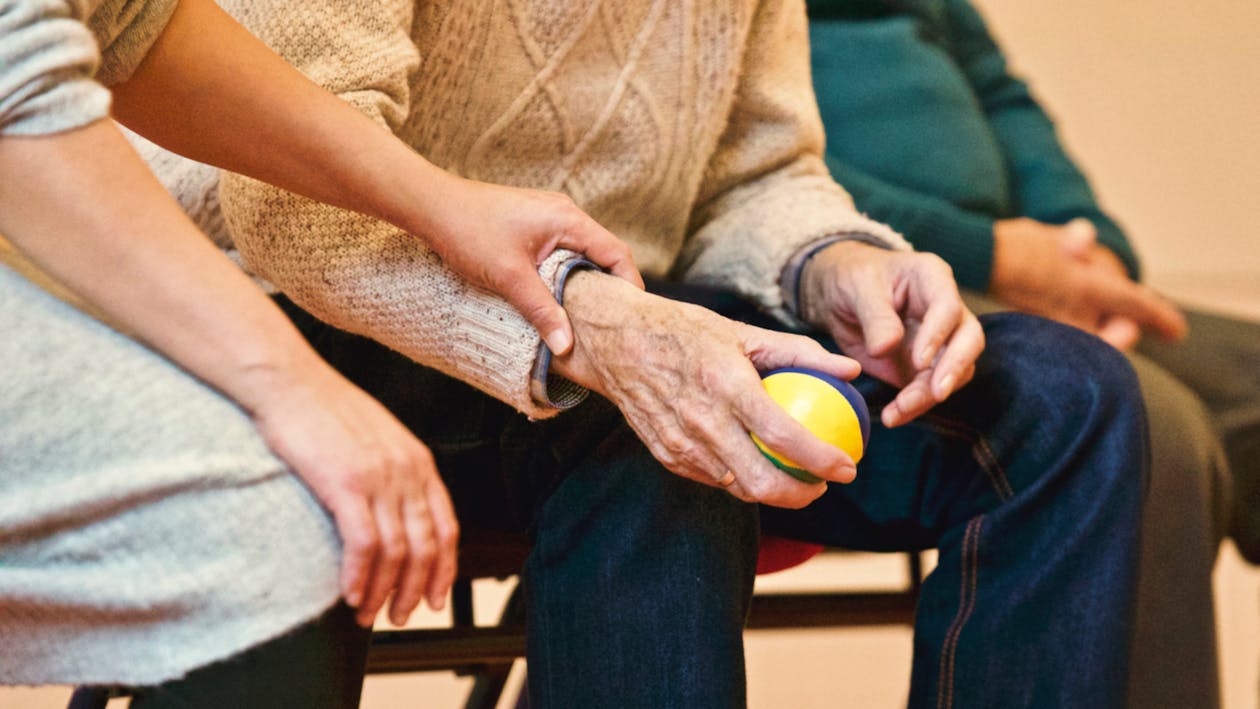
Person Holding a Stress Ball

I also began working with Alzheimer’s and Dementia patients once a week, something I initially thought would be a disheartening task. We did morning stretches with them as well and it’s something they do quite well at. We usually play classic music whilst performing these stretches and it surprised me at how many of them were able to remember each and every word of some of the songs. Music seems to have a special and enchanting effect on boosting their memories. The tasks we perform thereafter are usually simpler than bingo, as some patients have mild motor dysfunction. One day we simply spent a few hours blowing bubbles, and all the patients were greatly entertained and mesmerized by them, much like children. It truly showed me the wonderful impact that recreational therapy can have on their livelihoods, firsthand. 

I think geriatrics is often overlooked as a career pursuit by potential therapists. Most every other RT student I’ve spoken to plans to work with children, much as I planned to. However, there is a strong need for therapists in this specialty. Geriatric patients don’t have many options for activity in their day to day life, and recreational therapy alots time and creative methods to keep them engaged and to improve their overall quality of life.

The following article highlights how RT has aided dementia patients: https://www.ncbi.nlm.nih.gov/pmc/articles/PMC2780321/

The following video illustrates the importance of providing recreational activities for geriatric patients: https://youtu.be/xh1yo3WDxlA

Working with Special Needs

Although I have not yet professionally been in the work force, through shadowing I’ve gained insight as to what it’s like to work in a multitude of Recreational Therapy settings. In this post, I’m going to focus on what it’s like to work with Special Needs children, as well as what one should know before doing so. 

This is the area I plan to specialize in as a therapist. Six years ago, my brother was born with Down Syndrome. Prior to his birth, I was fairly uneducated on special education in general, having not been around many individuals with special needs. After his birth, I became very quickly involved working in such a setting. I volunteered at my school and through other organizations to work with Special Needs children. I knew immediately it was what I wanted to commit my life to doing, though I also recognized the large commitment of doing so.

Why is this a large commitment? Well, for starters there are many barriers, both physical and mental, that these patients have to overcome. Each patient has different abilities, and some are more high functioning in recreational activities than others. Some children are initially hesitant to do activities, while others will dive right in. Some don’t understand directions as clearly and others are very precise. Each patient is unique in their level of functioning.

Close-up of Woman Working

Recreational therapists often work with groups as well, which can make the therapeutic process even more challenging. Children with higher energy will do better at more intense activities, like swimming or running, while others are more physically limited. Therapy is a matter of keeping them all engaged in each activity chosen, and choosing activities that are suitable to everyone’s needs. 

When I first started working with Special Ed, I was surprised at how compliant many of the individuals were. Many are happy doing even the simplest of activities and become very passionate about what they are participating in. Overall, the community is extremely enthusiastic and eager to participate in the vast majority of activities. Therapy is a fantastic outlet for many of these children, while it simultaneously aids in their physical and mental health, encouraging them to expand in knowledge and capability.

Gemeinsames musizieren mit verschiedenen Instrumenten

The article following article illustrates the demand of therapists working with Special Needs individuals: https://www.specialneeds.com/activities/general-special-needs/what-recreation-therapy

The following video illustrates the benefits of music, one of the many activities potentially utilized by a RT, for special needs children: https://youtu.be/wXcmWwSQGI4

Applying to a RT Program

Like any other sort of therapy, Recreational Therapy is a competitive field. Most schools have a lengthy application process to ensure devotion and passion in the field. At ECU for example, students must complete a minimum of 25 shadowing hours, a cover letter, a resume, and a ten question interview. Then, a few are picked from the many applicants.

As this was my first time applying to an educational program with these requirements, I was left with a multitude of questions about the process: Who should I address in my cover letter? What should I include in my resume? What will they ask me in the interview? I wanted answers, and good answers at that.

In this post, I’m going to provide answers to as many questions about applying as possible, that I’ve learned through my own experience, and hope that this can serve as a sort of guide for other RT applicants. What follows is a list I’ve compiled on what RT administrators really want from students and potential students in their program.

Applicant filling in company application form document applying for job, or registering claim for health insurance
  1. Dedication

As previously stated, RT is a competitive field. This is due to it being a rigorous Bachelor’s degree, filled with medical classes, 40 credit hours specific to the program, and required shadowing and internships. Administrators and employers want to see high student involvement in the field; shadowing and volunteering at multiple locations related to the field. The more hours, the better.

2. Passion

One of the questions asked in my interview was: What is recreational therapy to you and what do you hope to do as a therapist? Recreational therapy requires a lot of patience and commitment to each individual patient. You’ll be working with individuals with special needs, in geriatrics, hospital patients, or veterans. Each of these individuals will have their own set of physical and mental barriers that they need to overcome. It will take time and not everyone will move at the same pace, but the goal should be to keep engaging them in activities that will boost their overall state of wellness.

3. People-Skills

Recreational Therapy absolutely requires one to be able to work very well interpersonally. The entire profession is based upon one’s ability to engage and interact with people. Strong leadership skills are also essential, as you will be directing groups of people to perform different activities

4. Creativity

Many RT’s are required to formulate their own fitness plan for patients, based on their individual needs and abilities. For example, when working in Geriatrics, activities cannot be too intense or strenuous; they must be simple to perform. On the other hand, if one is working with children or veterans, the activities will need to be more engaging and tedious, so as to properly physically challenge them.

Creative Story Book Near Black-framed Eyeglasses

The following article highlights the keys to success in becoming a recreational therapist: https://www.atra-online.com/page/BecomeAnRT

About Me

“ Carpe diem.”
Seize the day. An ideology I try to fervently live by.
My name is Annaliese Cofer; I’m a current junior at East Carolina university and an avid dreamer and doer. I like to think of myself as a versatile individual. Many, many things have peaked my interest on my quest for knowledge in life and I‘ve made it a point to immerse myself in a vast variety of activities.
Perhaps the seed of this was my childhood as a military brat. I’ve been fortunate enough to do a great deal of traveling because of this and have acquired a great passion for travel photography and blogging in the process. I’ve lived in 8 states and 2 countries, journeyed to China to adopt my brother, backpacked Europe, and attended a short excursion in London. Along with photography, I enjoy a multitude of outdoor activities like hiking, water sports, swimming, and jogging. But I also take great delight in many indoor pastimes. I love to write and one day plan to write a novel. I journal and scrapbook my travels and day to day life, I paint, and am in the process of learning how knit.

When picking a degree path, I decided I needed something I was passionate about, a path where I could help people, and a versatile career field. I settled upon Recreational Therapy as it included all of these checkpoints. I plan to work with Special Needs Children to engage them in a variety of exciting, hands on activities that will help them overcome any mental or physical barriers they may have. My main goal is to improve their overall quality of life. In this blog I will be illustrating the perspective of a RT student: taking a look at the classes in the Recreational Therapy program, the shadowing and workplace environment, and the future as an eventual therapist. I hope to give the reader an accurate and passionate overview of what the field entails, from starting at the beginning of it’s path as a student. My blog will function as a sort of guide; one that I wish I’d had when applying to ECU’s RT Program and one that will highlight the wonderful outcomes in pursuing this career.